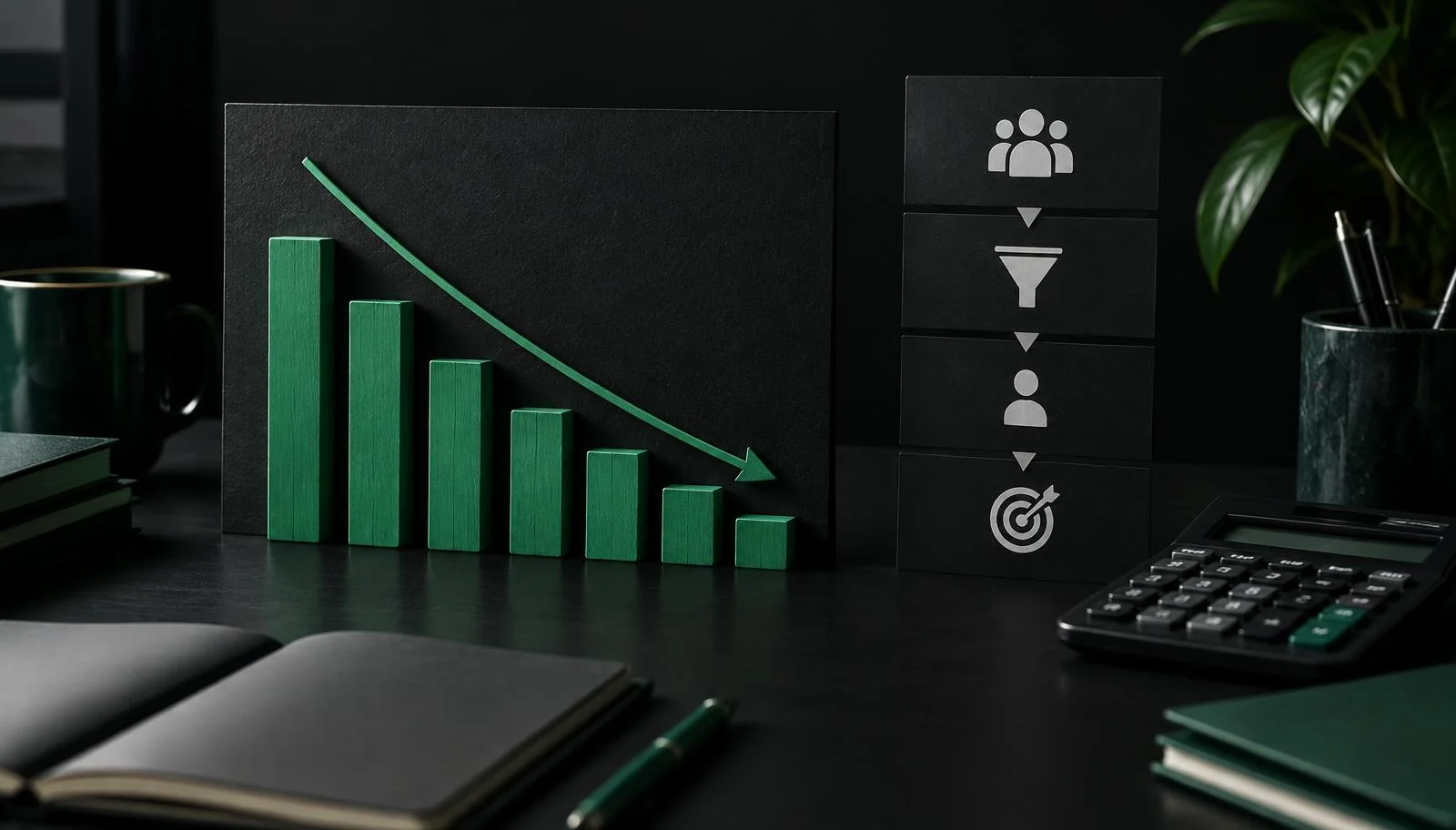
"Ads are expensive" is a sentence we hear most often when cost per lead climbs. In almost no case is the platform the problem. The problem sits in a layer that blocks better results on the same budget — and that layer is usually outside the ad account.
What is CPL and how do you calculate it?
CPL = Total ad spend ÷ Number of leads generatedSpend ₺30,000 and collect 200 form fills and your CPL is ₺150. The math is trivial. The difficulty is reading what the number means.
Wrong question, right question
The correct chain is CPL (cost per lead) → CPA (cost per appointment) → CAC (cost per customer). You can cut CPL from ₺150 to ₺60 and still raise your customer acquisition cost if none of those leads book. Judge every optimisation on CAC.
The seven steps that lower cost per lead
- Fix the offer first — a concrete result, a concrete timeframe, a concrete risk transfer.
- Add creative angles instead of narrowing audiences; broad targeting plus strong creative wins.
- Take creative volume seriously: 4-6 new creatives weekly, one new format monthly.
- Tune form friction deliberately: name, phone and one qualifying question.
- Cut response time to minutes with automated WhatsApp acknowledgement.
- Build a follow-up sequence out to day 7 — most closes happen after the third touch.
- Complete tracking and Conversions API, and feed real CRM closes back as offline conversions.
Case: ₺340 to ₺62
Vi Eyebrow aesthetics clinic started at ₺340 CPL. Month one reworked the offer and creative angles — ₺89. Month two raised creative volume to five variations weekly and rewrote the form with one qualifying question — ₺62. An 82% drop with no change in ad budget.
The cheap-lead trap
Watch three metrics while CPL falls: lead-to-appointment rate, show-up rate, and close rate. If they degrade, a falling CPL is not good news — you are buying cheaper but less relevant attention.
Next step
In a free 30-minute strategy session we identify which of the seven steps is missing in your account and hand you a clear 90-day plan.